
Heart Hum
Sound to rest in, and an honest account of what it does.
Long-form listening beds, built slowly and measured properly. We tell you what the research supports, where it runs out, and which parts are simply beautiful.
Pilot 01 is a 528 Hz themed bed, two hours, with a measured 6 Hz binaural tone layer underneath.
The promise
- 01
Made for length, not for a loop
Most frequency music is three minutes repeated until morning. Ours is written to run for two hours without a seam, so nothing wakes you to tell you a track has ended.
- 02
Measured, not just labelled
A number in a filename proves nothing. Where we claim a frequency, it was generated as its own waveform and verified after export, to within 0.02 Hz on our test renders.
- 03
Honest about the evidence
Music can genuinely support rest. The claim that a specific frequency performs a specific biological function is far weaker than the internet suggests. We say so on our own website.

How a track is made
Three layers, kept deliberately separate.
Because they are three different kinds of claim.
- The bed Composed
- The music itself: warm pads, felt piano, soft room tone. Written for low event density and gentle dynamics, so attention has nothing to catch on. This is a musical choice and we defend it as one.
- The tone layer Generated
- Where a track is named for a frequency, that frequency exists as its own sine wave, mixed quietly underneath. Pilot 01 carries a 528 Hz tone and a 6 Hz binaural difference, 132 Hz to the left ear and 138 Hz to the right.
- The measurement Verified
- Every export is analysed afterwards: zero-crossing checks on the tone, spectral checks on the modulation, both channels confirmed separately. A stereo file is not a guarantee until the two channels have been looked at on their own.
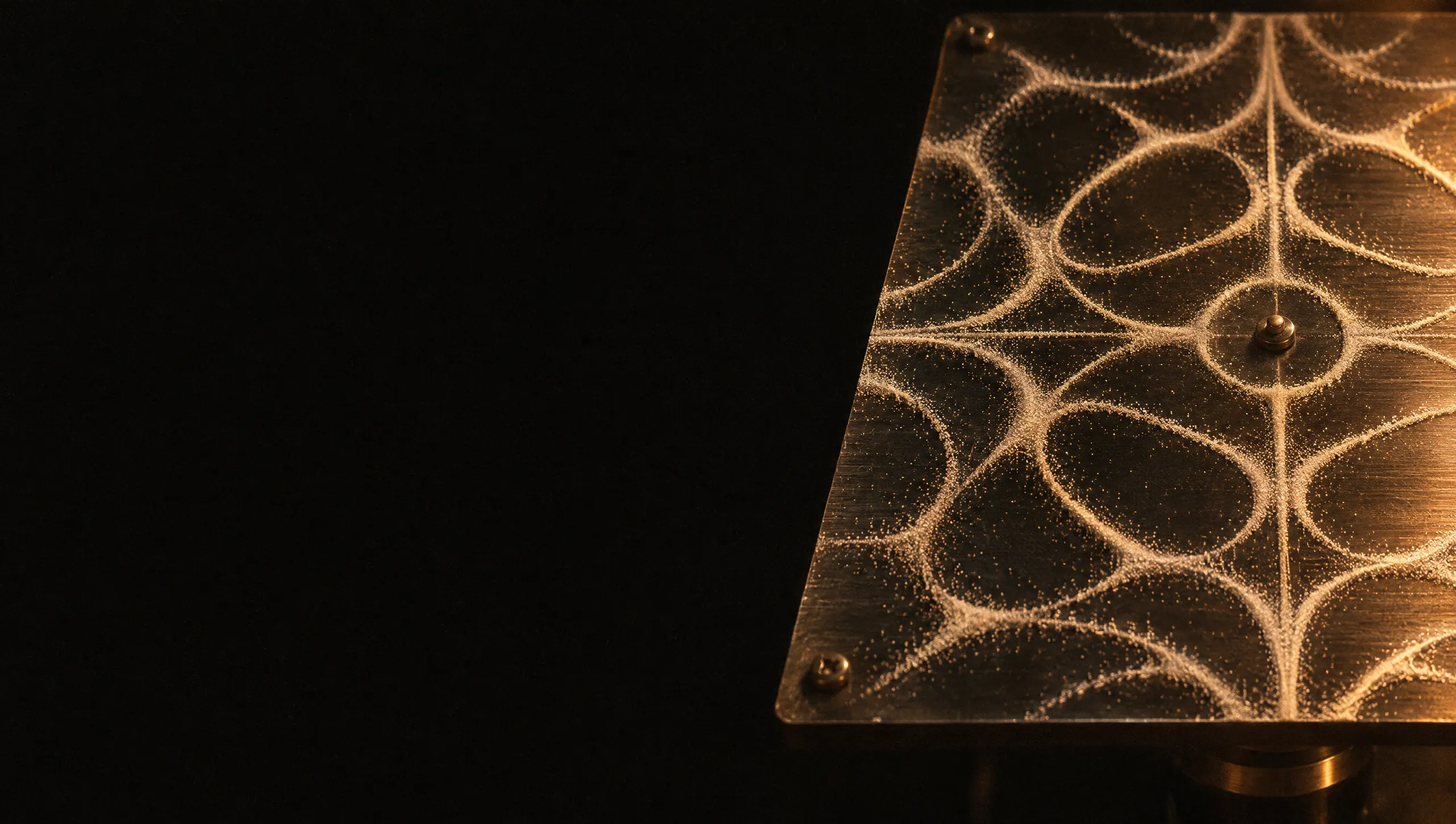
Behind this text, a Chladni plate makes a standing wave visible. Sand gathers where the surface is still.
What the research says
The section most sound healing sites do not have.
Every verdict below traces to a published source. The full list is at the foot of this page.
-
Music for rest and stress
Reasonable basisThe US National Center for Complementary and Integrative Health supports investigating music-based approaches for stress, anxiety and pain, while noting that findings vary by condition and intervention. Clinical music therapy evidence does not automatically transfer to generated music.
-
Music for sleep
Promising, self-reportedEncouraging for how well people report sleeping. Self-reported sleep quality and measured sleep are not the same thing, and a playlist is not a treatment for insomnia.
-
Binaural beats
MixedA 2023 systematic review of fourteen EEG studies found five supportive, eight contradictory and one mixed, with inconsistent stimulation and analysis between them. Plenty of people find the effect pleasant. Nobody has established a guaranteed brain state.
-
432 Hz and 528 Hz
Not establishedHuman studies exist, including one in 2026 with 162 participants across three groups. It reported changes in salivary biomarkers but no significant difference in Stroop task performance. A biomarker shift is not a clinical outcome. The frequently cited 528 Hz study from 2018 had nine participants and tested piano music tuned to A=444, not an isolated 528 Hz tone.
-
The solfeggio function map
SymbolicA modern symbolic palette, and a good one. We use the nine tones as creative themes because they produce genuinely different music. We do not assign each one a biological function, because this research found no robust basis for doing so.
-
Disease, DNA, detox, Rife
NoWe will not tell you that a frequency repairs DNA, clears an organ, kills a pathogen, detoxifies anything or treats a disease. An audio recording is also not a Rife device: those work by a different physical mechanism, and Cancer Research UK found no reliable evidence that Rife machines treat cancer.
The music is doing the work. The number on the label is a creative decision, and we would rather tell you that than sell you a mechanism.

The collections
Six arcs, grouped by what you are doing.
- Sleep and Wind-down Settling at the end of the day 30 min
- Calm and Unwinding Rest after something demanding 20 min
- Focus and Flow Unobtrusive background for work 45 min
- Meditation and Reflection Spacious, attentive listening 30 min
- Gentle Re-entry Coming back to ordinary activity 15 min
- Solfeggio Exploration Nine short studies, one tone each 27 min
Lengths are design targets. Durations become facts once a track is rendered and checked, not when it is planned.
Listening notes
Start quieter than feels right and stop whenever you want to. Tone layers and binaural differences need headphones to work as intended: a mono downmix turns a binaural pair into something else entirely.
Do not use the sleep material while driving or doing anything that needs your attention. If listening brings on discomfort, headache, dizziness or makes tinnitus worse, stop and choose something gentler.
On volume: the World Health Organization's reference for adults is 80 dB across 40 hours a week, with safe time falling as the level rises. A file's digital level cannot tell you the pressure at your ear, so no number we publish is a safe listening level for your setup.
New tracks, as they are finished.
One email when something is ready, with the specification and what we measured. No course, no frequency chart, no newsletter about the vibration of the universe.
We store the address to send those emails and nothing else.